Yosemite’s Hidden Architectural Gems: A Must-See for Every Travel Enthusiast
Nestled within towering granite cliffs and ancient sequoias, Yosemite National Park surprises many with its stunning human-made structures. Far from just natural beauty, the park boasts iconic lodges and bridges shaped by early 20th-century design. I was blown away by how architecture here blends seamlessly with wilderness—rustic, bold, and timeless. This is not just scenery; it’s a crafted experience you have to see to believe. While millions visit each year for the waterfalls and hiking trails, relatively few pause to appreciate the quiet genius of the buildings that frame their journey. These structures do not shout for attention; they whisper, inviting closer inspection. They are part of a larger story—one of vision, restraint, and deep respect for the land. For travelers who value both nature and design, Yosemite offers a rare harmony where human hands have enhanced, not interrupted, the wild.
The First Glimpse: When Nature Meets Design
As visitors enter Yosemite National Park, the overwhelming first impression is one of raw, untamed nature—sheer rock faces rising thousands of feet, meadows dotted with wildflowers, and rivers winding like silver threads through the valley floor. Yet, almost imperceptibly, architecture begins to shape the experience from the very start. At the park’s southern entrance near Wawona, stone gateposts flank the roadway, built from locally quarried granite and topped with wooden beams. These unassuming markers are not merely functional; they serve as a threshold, signaling a transition from the modern world into a landscape carefully preserved and thoughtfully framed.
This intentional blending of built form and natural setting reflects a design philosophy known as National Park Service Rustic, or affectionately, "Parkitecture." Developed in the 1910s and formalized in the following decades, this style emphasizes harmony with the environment through the use of native materials and handcrafted construction techniques. Buildings are designed to appear as though they emerged organically from the earth, using timber from nearby forests and stone gathered on-site. Roofs are low-pitched, walls are thick and textured, and colors are drawn directly from the surrounding terrain—earthy browns, grays, and mossy greens. The goal is never to impress with scale or ornamentation, but to disappear into the landscape while still serving human needs.
One of the earliest examples of this approach can be found at the Wawona Entrance Sign, where a simple wooden arch supported by stone piers welcomes travelers into the park. Though modest in size, the structure carries symbolic weight, representing the beginning of a journey guided by conservation principles. Early park planners understood that the way people entered the park would shape their expectations and behaviors. By using natural materials and understated forms, they encouraged reverence rather than conquest. Even today, driving beneath that arch feels like crossing a quiet boundary—not just geographically, but emotionally and spiritually.
The success of this design lies in its subtlety. Visitors may not consciously notice the craftsmanship of a stone culvert or the careful alignment of a wooden railing, but they feel its effect. These details create a sense of continuity, reinforcing the idea that humans are guests in this space, not masters. As tourism increases and infrastructure demands grow, maintaining this balance becomes more challenging. Yet, every new structure added to Yosemite still adheres to these foundational principles, ensuring that the park’s architectural language remains consistent across generations.
Ahwahnee Lodge: Where Grandeur Lives in Wood and Stone
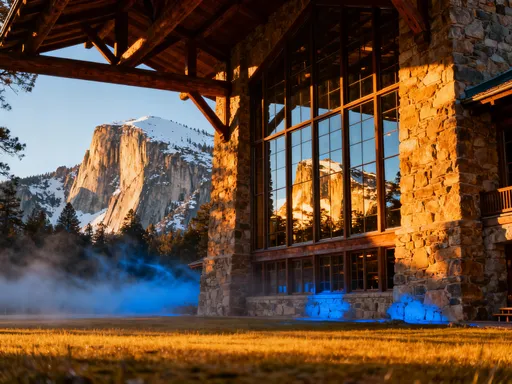
Rising majestically against the backdrop of Glacier Point and Half Dome, the Ahwahnee Lodge stands as one of the most remarkable examples of rustic grandeur in any national park. Completed in 1927 and designed by architect Gilbert Stanley Underwood, the lodge was conceived not merely as a place to sleep, but as a destination in itself—a sanctuary where art, nature, and hospitality converge. Its massive stone fireplaces, soaring timber trusses, and hand-carved stonework reflect a level of craftsmanship rarely seen in modern construction. Every element, from the wrought-iron chandeliers to the handwoven Native American-inspired textiles, was chosen to evoke a deep connection to the Sierra Nevada landscape.
What makes the Ahwahnee truly exceptional is its ability to feel both monumental and intimate. The great hall soars over two stories, with walls of glass offering uninterrupted views of Yosemite Falls and the surrounding cliffs. Yet, despite its size, the space feels warm and inviting, thanks to the rich textures of wood and stone, the soft glow of ambient lighting, and the careful arrangement of seating around central hearths. This duality—between grandeur and comfort—was intentional. Underwood sought to create a building that honored the scale of the natural world while providing a refuge for weary travelers. He succeeded beyond measure.
The architectural influences at play are diverse and deliberate. Underwood drew inspiration from medieval great halls, Native American building traditions, and the clean lines of Art Deco design. The result is a unique aesthetic that feels timeless rather than trendy. The lodge’s massive stone chimneys echo the verticality of the surrounding cliffs, while the horizontal log beams mirror the layered rock formations. Even the color palette—deep forest green, warm amber, and charcoal gray—was selected to complement the hues of the valley. It is no exaggeration to say that the Ahwahnee does not sit in Yosemite; it belongs to it.
Over the decades, the lodge has hosted presidents, royalty, and countless families seeking a memorable mountain retreat. In 2019, after a careful restoration project, it was officially renamed The Majestic Yosemite Hotel, though many still refer to it by its original name. Regardless of title, its cultural and architectural significance remains unchanged. It continues to operate under strict preservation guidelines, ensuring that future visitors experience the same awe-inspiring atmosphere. For those planning a trip, booking well in advance is essential—rooms fill quickly, especially during peak seasons. But even a daytime visit allows guests to appreciate the craftsmanship, sip tea by the fireplace, or attend one of the seasonal cultural programs hosted in the great hall.
Curry Village: Simplicity with a View
If the Ahwahnee represents the pinnacle of mountain luxury, Curry Village embodies the spirit of accessible adventure. Originally established in 1899 by David and Jennie Curry as a camp for families and young travelers, the site began as a collection of canvas tents with wooden floors. Over time, it evolved into a year-round destination offering a range of accommodations, from updated tent cabins to standard hotel rooms. Yet, despite modern upgrades, Curry Village has retained its core identity—a place where comfort meets simplicity, and where the focus remains firmly on the surrounding wilderness.
The architecture here reflects a practical, functional approach. Low-slung buildings with exposed beams and stone foundations blend into the forest edge, avoiding visual competition with Yosemite’s iconic landmarks. The central pavilion, which houses the dining hall and guest services, features wide eaves and large windows that invite natural light while offering shelter from rain and snow. Communal fire pits and outdoor seating areas encourage social interaction, fostering a sense of community among guests. Unlike the formal elegance of the Ahwahnee, Curry Village feels lived-in and welcoming—a home base for hikers, climbers, and nature lovers.
One of the most striking aspects of Curry Village is its ability to accommodate thousands of visitors without overwhelming the landscape. This is achieved through careful site planning and low-impact construction methods. Buildings are clustered to minimize forest disruption, pathways are made of compacted gravel to reduce runoff, and lighting is designed to minimize glare and light pollution. Even the newer cabins, constructed with energy-efficient materials and sustainable practices, adhere to the park’s architectural standards. The result is a development that feels temporary, even though it has stood for over a century.
For families and budget-conscious travelers, Curry Village offers an invaluable entry point into the Yosemite experience. Children delight in the open spaces, parents appreciate the proximity to trailheads and shuttle stops, and all benefit from the sense of shared purpose that comes from being surrounded by fellow explorers. It is a place where memories are made not in opulence, but in connection—with nature, with loved ones, and with the simple joy of being outdoors. In many ways, Curry Village proves that thoughtful design does not require extravagance to be meaningful.
Wawona Hotel: Stepping Back into Victorian Elegance
Tucked away in a quiet grove of giant sequoias, about 27 miles from Yosemite Valley, the Wawona Hotel offers a distinctly different rhythm from the park’s more famous destinations. Built in 1876 and expanded over the following decades, this historic property transports guests to a gentler era of travel—one defined by slow journeys, handwritten letters, and afternoons spent rocking on a wide porch with a cup of tea. With its white clapboard siding, green shutters, and expansive wraparound verandas, the hotel resembles a New England inn or a Southern plantation house more than a mountain lodge. Yet, it fits perfectly within its setting, standing as a testament to the diversity of architectural expression within the park.
The hotel’s design reflects the tastes and values of its time. During the late 19th century, tourism in Yosemite was still in its infancy, and accommodations were designed to appeal to Easterners accustomed to formal hospitality. Wawona’s wide porches, symmetrical layout, and ornate woodwork provided a sense of familiarity and refinement amidst the rugged wilderness. Today, the hotel retains much of its original character, including gaslight-style electric fixtures, antique furnishings, and period-appropriate décor. Guests who stay in the historic rooms trade modern amenities for charm—expect ceiling fans instead of air conditioning, and shared bathrooms in some cases. But for many, these “inconveniences” are part of the appeal.
What makes Wawona truly special is its atmosphere. The pace of life slows the moment you arrive. Birds sing in the trees, the scent of pine fills the air, and the only sounds are the creak of rocking chairs and the distant rustle of leaves. The hotel’s location, near the Mariposa Grove of Giant Sequoias, makes it an ideal starting point for quieter hikes and less crowded experiences. It also serves as a reminder that Yosemite has always been more than just a destination for adrenaline seekers—it is a place for reflection, rest, and renewal.
Preservation efforts at Wawona have focused on maintaining authenticity while ensuring safety and comfort. The National Park Service and its partners have undertaken careful restoration projects to repair aging woodwork, reinforce foundations, and upgrade utilities without compromising historical integrity. As a result, the hotel remains fully operational year-round, welcoming guests who appreciate its unique blend of history and hospitality. For those looking to escape the busier parts of the park, Wawona offers a peaceful alternative—one where architecture doesn’t just shelter, but soothes.
Bridges and Trails: Engineering That Disappears into Scenery
While lodges and hotels often receive the most attention, some of Yosemite’s most impressive architectural achievements are found in its infrastructure. The park’s network of bridges, retaining walls, and trailside shelters demonstrates a level of craftsmanship and sensitivity that is easy to overlook but impossible to ignore once noticed. These structures serve vital functions—carrying roads over rivers, stabilizing slopes, and guiding foot traffic—but they do so with such subtlety that they appear to be part of the natural landscape.
Take, for example, the stone-faced bridges that cross the Merced River throughout the valley. Built in the 1920s and 1930s, these arch bridges use locally quarried granite fitted together without mortar, their curves echoing the natural contours of the riverbanks. From a distance, they look like ancient formations, as if shaped by water and time rather than human hands. Yet, they are fully functional, capable of withstanding seasonal floods and heavy use. Park engineers designed them to be low and wide, minimizing visual impact while maximizing durability. Handrails are made of forged iron or peeled logs, chosen for both strength and aesthetic compatibility.
Similarly, the trail system throughout Yosemite incorporates countless examples of dry-stack stone walls—retaining structures built without cement, using only carefully balanced stones. These walls follow the natural slope of the land, supporting paths that wind through forests, meadows, and rocky outcrops. They require constant maintenance, especially after winter storms, but their longevity is a testament to the skill of the builders. Many were constructed by the Civilian Conservation Corps during the 1930s, a federal work program that employed young men to improve public lands during the Great Depression. Their legacy lives on in every hand-laid stone and thoughtfully placed switchback.
Even the park’s signage and information kiosks adhere to the rustic design standard. Wooden posts, carved lettering, and stone bases ensure that directional signs and interpretive panels feel like natural extensions of the environment. There are no neon lights, plastic panels, or metal poles to disrupt the visual harmony. This attention to detail extends to parking areas, restrooms, and picnic shelters—all built with the same commitment to integration. The result is a park where infrastructure supports the experience without ever stealing the spotlight.
Why This Architecture Still Matters Today
In an age of rapid development and increasing environmental pressures, Yosemite’s architectural legacy offers a powerful model for sustainable design. Unlike many modern resorts that dominate their surroundings with glass towers and sprawling footprints, the buildings in Yosemite were created to recede, to listen, to respond. They embody a philosophy of humility—one that recognizes the primacy of nature and seeks to enhance, not overshadow, the landscape. This approach is more relevant now than ever, as climate change, overcrowding, and habitat loss threaten the very ecosystems these structures were built to celebrate.
The enduring popularity of Yosemite proves that people are drawn not just to wild places, but to places where care has been taken. Visitors remember not only the view of El Capitan at sunrise, but the warmth of the fire in the Ahwahnee’s great hall, the sound of rain on the roof of a Curry Village cabin, or the creak of a rocking chair on the porch of the Wawona Hotel. These sensory experiences are shaped by architecture, and they linger long after the trip ends. They remind us that thoughtful design can deepen our connection to nature, rather than distract from it.
Preservation efforts within the park continue to prioritize authenticity and sustainability. Restoration projects use traditional materials and techniques whenever possible, from hand-split shingles to lime-based mortars. Modern upgrades—such as energy-efficient heating systems or water-saving fixtures—are integrated discreetly, ensuring that functionality does not come at the cost of character. Park rangers and historians work closely with architects and conservationists to ensure that every decision aligns with the original vision.
Moreover, Yosemite’s architectural principles have influenced park design across the United States and beyond. The idea that buildings should belong to their place, not impose upon it, has become a cornerstone of environmental planning. From Grand Teton to Acadia, echoes of Parkitecture can be seen in lodges, visitor centers, and trailside shelters. For families, educators, and travelers interested in sustainability, Yosemite offers not just beauty, but a lesson in how to build responsibly in fragile environments.
Planning Your Own Architectural Adventure in Yosemite
To fully appreciate Yosemite’s architectural treasures, a bit of planning goes a long way. The best way to experience the contrast between styles is to visit multiple areas of the park, allowing time to absorb the different atmospheres. Begin at the South Entrance to explore the Wawona Hotel and Mariposa Grove, where the slower pace sets a reflective tone. From there, descend into Yosemite Valley to see the Ahwahnee Lodge and Curry Village, noting how each responds to its surroundings in distinct ways. Early morning or late afternoon visits are ideal, when the low-angle sunlight enhances the textures of stone, wood, and bark, creating a warm, golden glow.
Guided tours led by park rangers offer valuable insights into the history and design principles behind the structures. These programs, often free with park admission, cover topics ranging from the construction of the Ahwahnee to the role of the Civilian Conservation Corps in shaping the park’s infrastructure. For those who prefer independent exploration, the official Yosemite National Park map includes an architectural trail highlighting key sites, complete with brief descriptions and walking distances. Bringing a camera is recommended, but equally important is taking time to simply sit and observe—architecture in Yosemite is best experienced through presence, not just photographs.
Accommodations should be reserved well in advance, especially for the Ahwahnee and Wawona Hotel, which operate at limited capacity to preserve their historic character. For families, Curry Village offers a practical and immersive option, particularly for those planning extensive hiking. Packing layers is advisable, as temperatures can vary significantly between day and night, and weather changes quickly in the mountains. Comfortable walking shoes, a reusable water bottle, and a sense of curiosity are essential.
In the end, Yosemite’s buildings do more than provide shelter—they connect. They remind us that even in the wildest places, human creativity can coexist with nature when guided by humility, vision, and respect. This is not just travel; it’s a dialogue between earth and art, a conversation that continues with every carefully placed stone and every hand-hewn beam. For every traveler who seeks meaning in their journey, Yosemite’s hidden architectural gems offer a profound and lasting answer.